(traduction à venir)
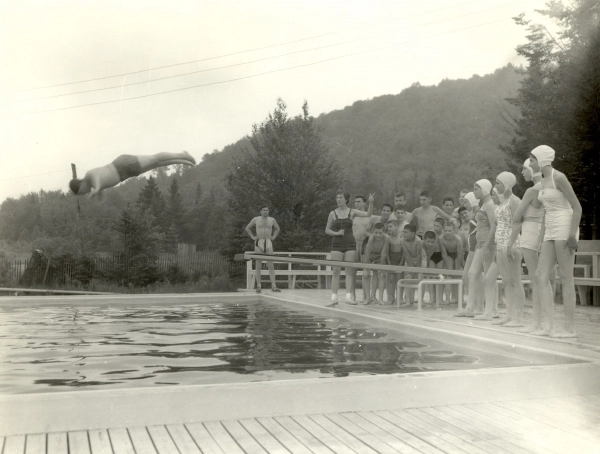
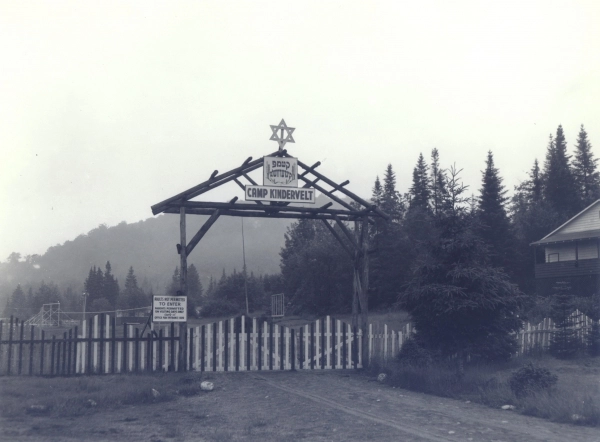
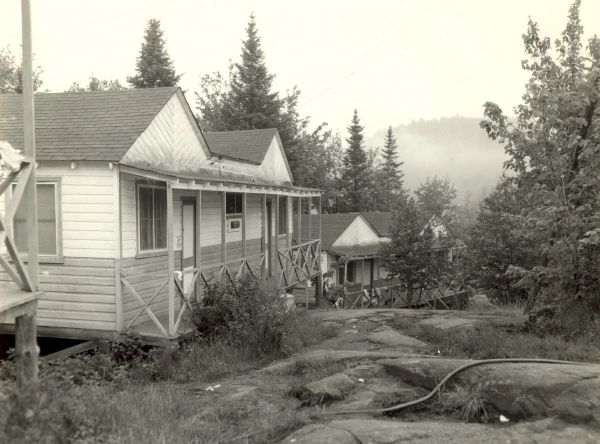
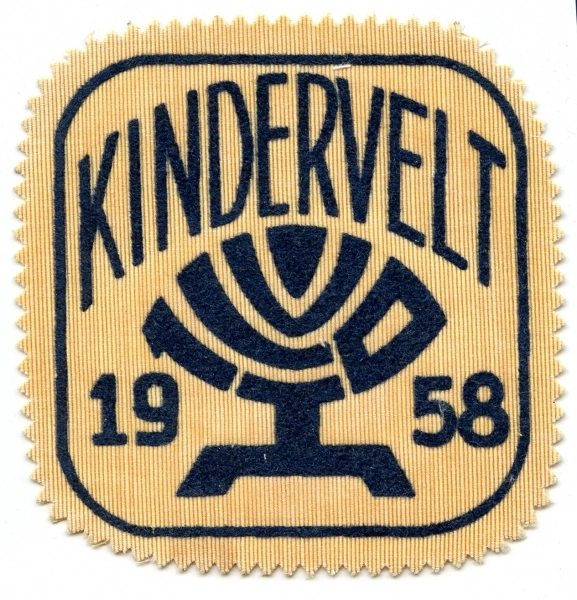
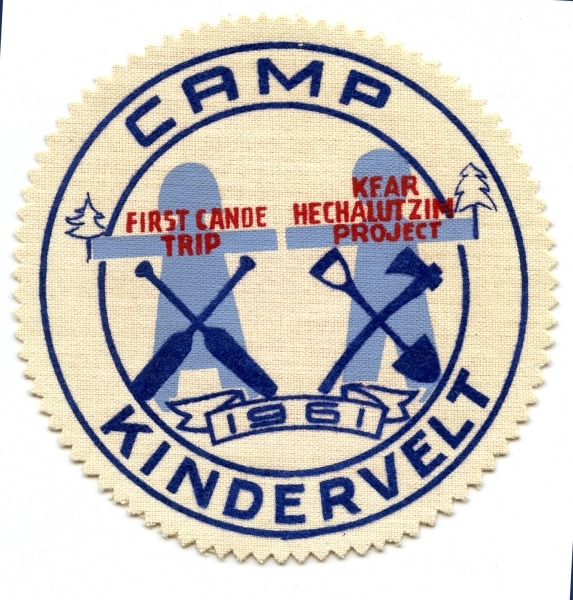
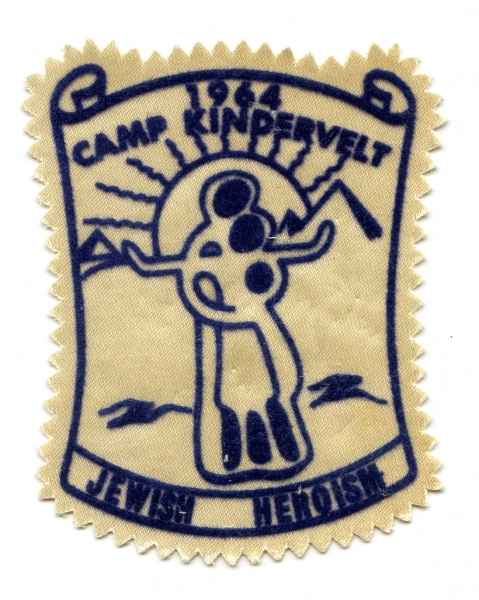
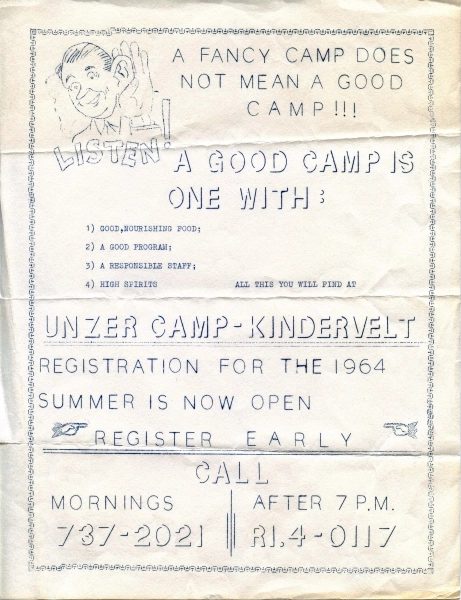
Located in Prefontaine, Quebec, Unzer Camp and Kindervelt was described as “a glorious colony for children and adults in the heart of the Laurentian Mountains.” In reality, this “summer home of the Montreal Labour Zionist Movement” was a very modest camp; until a pool was built in the 1950s, campers had to cross the road to go swimming in a nearby creek. The cabins were humble, but as one Kindervelt poster explained, “A fancy camp does not mean a good camp!” Nevertheless, Kindervelt was a beloved retreat from city life.
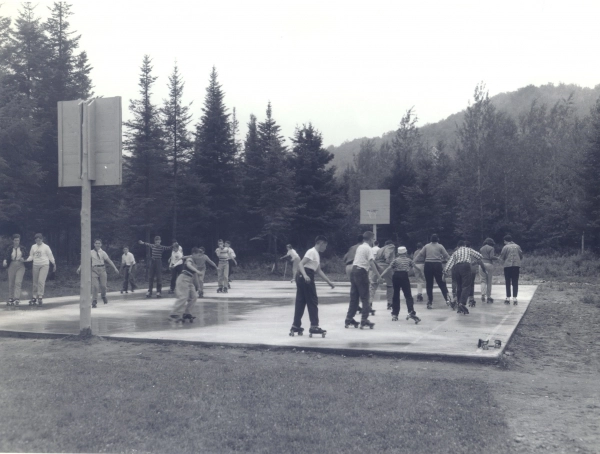
Founded by Labour Zionists in 1931, Kindervelt offered a “Healthy Jewish Atmosphere” where children played sports, went on hikes, and learned about their cultural heritage, singing songs and performing plays in Yiddish and Hebrew. The eight “bunks” that children stayed in were named after Zionist leaders and Jewish writers: Arlosoroff, Bialik, Borochov, Chizik, Gordon, Sholem Aleichem, and Trumpeldor. Campers and counsellors came from Toronto, Ottawa, and even from New York, but most were from Montreal. Many were students or teachers at the Peretz Shule or the Yidishe Folks Shule. For most of its existence, Yiddish was a natural, unmarked part of the “Jewish atmosphere” cultivated at Kindervelt. But by the 1940s, although the performances were in Yiddish, as were the announcements and the much of the camp’s correspondence, the children preferred to speak English amongst themselves.
Camps for children often had related adult camps. At Kindervelt, this was Unzer Camp. Adults could stay for a vacation with like-minded peers, and be close to their children, whom they could visit on Saturdays. Well-known entertainers provided a “full social programme,” and many who were affiliated with Labour Zionism or the Yiddish school systems also built cottages nearby, allowing them to participate in camp life.
Being affiliated with the Farband Labour Zionist movement, the camp was not religious, though it placed a strong emphasis on Jewish tradition. In the 1940s, Friday nights meant showers (outdoors), dressing in white, and “Israeli dancing.” On Saturday evenings, the children might perform a play for the adults at Unzer.
Unzer Camp and Kindervelt were part of a larger movement of Jewish summer camps that spanned the entire political spectrum. (There were actually five different camps across North America called Kindervelt.) Giving their children a chance to spend time in the healthy country air was important to urban families, and camps like Kindervelt aimed to be as affordable as possible: in 1937, a week at Kindervelt cost $12. Members of trade unions and their families could vacation at a discounted price.
As the use of Yiddish as a secular vernacular declined in the 1950s, its importance at Kindervelt also waned. At the same time, the importance of Hebrew increased. In 1965 Kindervelt merged with the Montreal Habonim and Camp Kvutza, and was renamed Camp Dan. Eventually it closed too, in 1970.
Compiled by Magdalene Klassen.
Sources
Freidenreich, Fradle Pomerantz. Passionate Pioneers: The Story of Yiddish Secular Education in North America, 1910–1960. Teaneck, NJ: Holmes & Meier Publishers, 2010.
Goldberg, Jonathan J. and Elliot King. Builders and Dreamers: Habonim Labor Zionist Youth in North America. New York: Herzl Press, 1993.
Klassen, Magdalene. Interview with Fradle Freidenreich. 20 Jul. 2015.
Klassen, Magdalene. Interview with Rosa Finestone. 23 Jul. 2015.
Patches and Poster. JewCan boxes, Summer Camps, Kindervelt folder.
Photo Album. 1957. P0118; MC 27-3-5, Judith and Morris Oberman Fonds, Canadian Jewish Congress Charities Committee National Archives.
*Images courtesy of the Jewish Public Library Archives and the Canadian Jewish Congress Charities Committee National Archives.