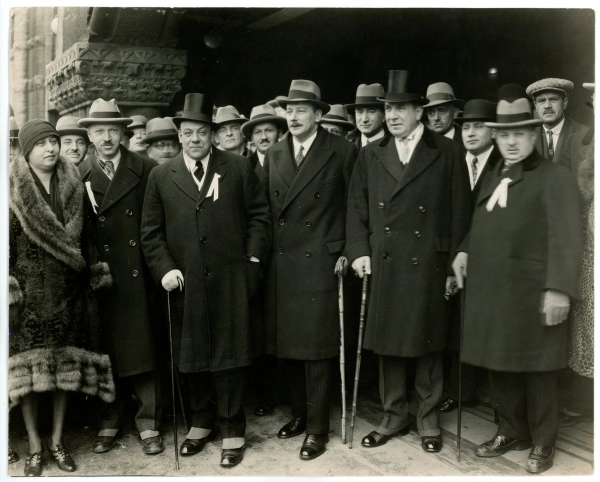
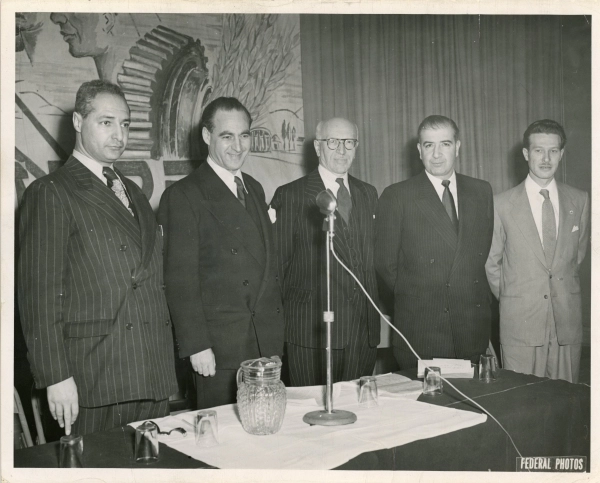
Louis Fitch (1888-1956) was a lawyer, Zionist activist, and member of the Quebec Legislative Assembly with the Union Nationale party. Born in Suceava, Romania in 1888, he came to Canada in 1891. He adopted the anglicised surname Fitch in 1912.
He studied at the High School of Quebec before entering the Faculty of Law at McGill University. He was called to the Quebec Bar in 1911. He was then awarded the Sir William Macdonald Travelling Scholarship to study at the Sorbonne University in Paris in 1912. Upon his return to Montreal, he practised law with the firm of Jacobs, Hall, Couture and Fitch until 1919, and was made King’s Counsel in 1925. When the announcement was published in the Keneder Adler, Peter Bercovitch, a political rival of Fitch’s, was so surprised that he wrote a letter to Hirsch Wolofsky to make sure it was not a mistake. Furthermore, Bercovitch wrote a letter to Premier Louis-Alexandre Taschereau to inquire about the reasons for this appointment. Premier Taschereau responded, arguing that Fitch had the qualities worthy of being King’s Counsel.
His political involvement began with the Zionist movement in Canada. Fitch was appointed vice-president of the Canadian Zionist Organization in 1918, working with Clarence de Sola, and participated in the founding of the Canadian Jewish Congress as its first secretary. Internationally, he also participated in the Eleventh Zionist Congress in Vienna in 1913. He was also involved in the Jewish Community Council in the 1920s.
Peter Bercovitch had held the seat of the provincial riding of Saint-Louis for the Liberal Party of Quebec since 1916. Samuel W. Jacobs, a partner at Louis Fitch’s law firm, had been the Member of Parliament for the same neighbourhood’s federal riding. When Jacobs died in 1938, Peter Bercovitch left his provincial seat vacant to inherit the federal seat. In the by-election Bercovitch’s resignation triggered, Louis Fitch was elected as a Union Nationale member of Parliament for the riding, an incredibly rare instance of support by the Jewish community for the nationalist party. He was committed to his Montreal riding that was home to Jews, Francophones and Anglophones. As a member of the Quebec Legislative Assembly, Fitch led a campaign aimed at exposing Nazism in Quebec, especially its organisations and its leader, Adrien Arcand. He also frequently petitioned Premier Maurice Duplessis on behalf of Jewish workers.
He ran again in St. Louis in the 1939 provincial general election. He began his campaign on October 8, 1939, at the Talmud Torah Hall, shortly after war broke out in Europe. Some in the French-language press accused him of political hypocrisy. According to them, the war on Nazism did not align with pro-Duplessis politics in the way Fitch presented. Newspapers, such as Le Devoir, saw in the Union Nationale an authoritarian and anti-Semitic political force. Fitch argued that his loyalty to Maurice Duplessis and his commitment to fighting Nazism were in no way mutually exclusive. Fitch insisted that he understood that “for us [Jews], the war against Hitler and Hitlerism is a battle for life.” On the election night of October 25, 1939, Fitch was defeated by the Liberal candidate Maurice Hartt.
In addition to his political career, Louis Fitch also left a historiographical contribution through two publications: Tercentenary History of Quebec (1908) and The Disestablishment of the Anglican Church in Wales (1909).
Compiled by Xavier Lévesque
(Traduction à venir)