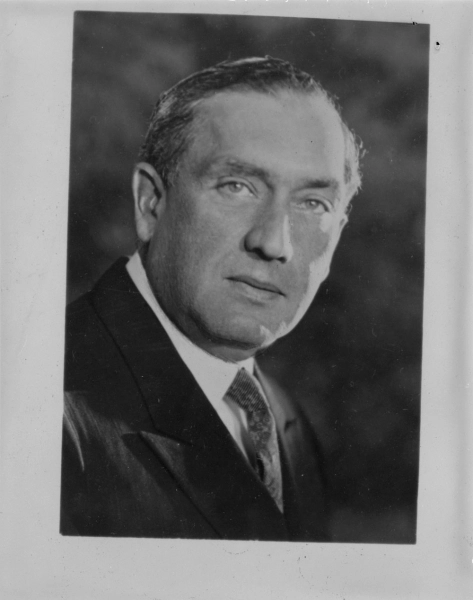
Peter Bercovitch (1879 –1942) was a prominent political figure in Montreal’s Jewish community in the first half of the 20th century. His parents were immigrants from the Russian Empire and his father worked in the garment industry. Bercovitch was born on September 17, 1879 in Montreal. Raised in the working-class, majority-Jewish, Downtown neighbourhoods of Saint-Louise and Saint-Antoine, he attended public school before studying law at McGill University and then resumed his legal studies in French, this time at Laval University in Montreal, later called the Université de Montréal.
He was called to the Bar of the Province of Quebec on November 26, 1901 and co-founded the firm of Bercovitch, Cohen & Spector in 1905. Fluent in both English and French, Bercovitch was lauded as a skilled public speaker. He also gained a reputation as a working-class man who was able to make a name for himself in the upper class, especially through his membership in organisations such as the Liberal Party of Canada’s Laurier Club. Bercovitch was made a King’s Counsel in 1911.
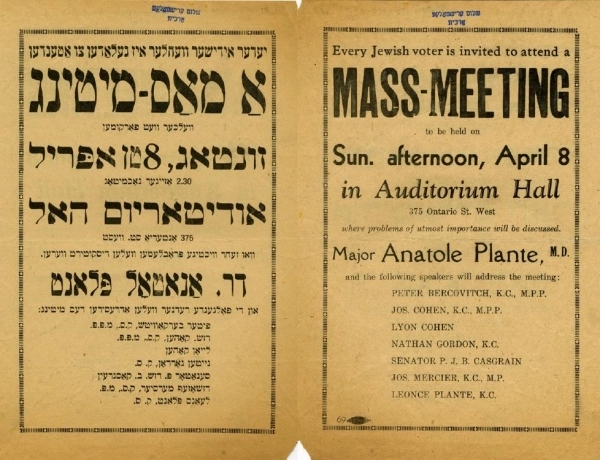
He was elected in 1916 under the banner of the Liberal Party of Quebec in the riding of Saint-Louis in Montreal, and was re-elected in the same riding six times (1919, 1923, 1927, 1931, 1935 and 1936). Bercovitch had a reputation of a hard-working politician, who mostly laboured behind the scenes. In the legislature, he was known to have sat on several important parliamentary committees. He also served as president of the Jewish Immigrant Aid Society in 1921.
In the 1930s he worked on the Jewish Schools Bill, which became known as “The Bercovitch Bill.” The Bill, aimed at resolving the “Jewish School Question,” initially proposed that publicly-funded Jewish schools be established in Montreal if Protestant administrators and the Jewish community could not agree on the conditions for attendance at Protestant schools. After Bercovitch gave his bill more teeth by including the creation of a Jewish section in the Conseil de l’Instruction publique, Liberal Premier Louis-Alexandre Taschereau declared to the legislature that Bercovitch’s bill would lay the foundation for a new system of schools in the province.
Later, in May 1936, the Leader of the Opposition, Maurice Duplessis, convened the Public Accounts Committee. Responsible for examining public finances, it had not met in over two years. There, Duplessis dealt a hard political blow to the established Taschereau government. As a loyal Liberal, Peter Bercovitch attempted an almost solitary defence in face of the Union Nationale leader. This political thrust and parry between Bercovitch and Duplessis was immortalised on-screen during the first episode of the 1978 series Duplessis, in a scene written by Denys Arcand.
In 1938, Peter Bercovitch entered federal politics in a by-election in the federal riding of Cartier – geographically equivalent to his provincial riding of 22 years – left vacant by the death of Samuel Williams Jacobs. The provincial seat he left was won by Louis Fitch, a Jewish member of Duplessis’ Union Nationale party, and a political rival. Running unopposed, he was re-elected in 1940 and died in office at the age of 63. The by-election in Cartier that followed Bercovitch’s death sent Fred Rose to the House of Commons, the first Communist MP in the history of the Canadian Parliament.
Complied by Xavier Levésque
Sources
Bercovitch, Peter, Peter Bercovitch fonds, Library and Archives Canada. http://central.bac-lac.gc.ca/.redirect?app=fonandcol&id=103306&lang=eng
Jewish Daily Bulletin, Wednesday, Feb. 26, 1930, 3. Quebec Government to Offer Bill for Separate Montreal Jewish Schools. http://pdfs.jta.org/1930/1930-02-26_1600.pdf?_ga=2.178742820.1620723893.1662149045-1512008750.1651771925